Beyond the Tracks: How APM''s $73M Rail Expansion Reshapes US Supply Chain

Emily Rodriguez
Cross-Border Trade Reporter
April 9, 2026
DATELINE: NA TRADE WIRE
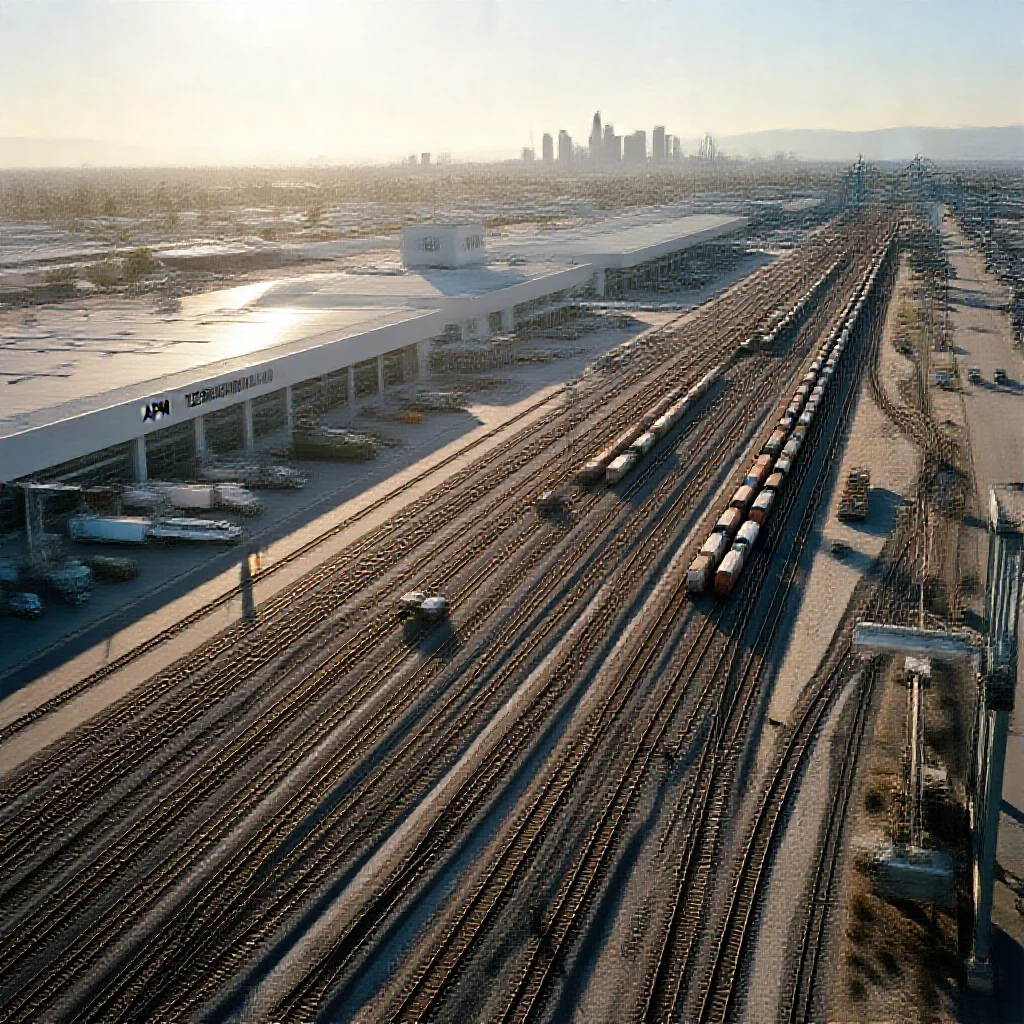
"APM Terminals'' recent $73 million rail expansion at the Port of Los Angeles,"
Beyond the Tracks: How APM's $73M Rail Expansion Reshapes US Supply Chain Economics
The Surface Facts: A $73 Million Capacity Injection
APM Terminals has completed a $73 million infrastructure expansion at its facility within the Port of Los Angeles. The project added 12,000 feet of new track, increasing the terminal's annual on-dock rail capacity to 1.5 million twenty-foot equivalent units (TEUs) (Source 1: [Primary Data]). The stated operational objective is to shift a significant volume of container movements from road to rail, with an expected reduction of 1.3 million truck trips from Southern California highways over the next two decades (Source 1: [Primary Data]). The completion date of Q4 2024 positions the enhanced terminal to be fully operational for the 2025 shipping season, a period when the global logistics industry continues to reconfigure networks in the wake of pandemic-era disruptions.
The Hidden Calculus: Rail as a Strategic Insulator
The investment represents more than a capacity upgrade; it is a strategic maneuver to insulate the integrated logistics network of APM’s parent company, A.P. Moller-Maersk. On-dock rail provides a controlled conduit for containers, shielding them from external variables such as port-area trucking shortages, drayage cost volatility, and local highway congestion. The economic return on investment is therefore calculated not solely on terminal throughput metrics but on securing reliable, predictable cargo flow for Maersk’s global shipping and logistics services. This expansion also serves as a direct competitive lever. Terminals with superior on-dock rail capabilities offer a more attractive and efficient gateway for cargo owners, drawing volume away from facilities that rely on slower, less reliable truck moves to off-dock rail yards.
The Ripple Effect: Reshaping Regional Freight Patterns
The projected elimination of 1.3 million truck trips will have measurable secondary effects. It will reduce congestion on key corridors like the I-710, lower associated emissions, and potentially alter logistics cost structures for businesses throughout the region. The expansion also strengthens the operational role of the Pacific Harbor Line and connecting Class I railroads within port logistics, potentially shifting pricing and service dynamics in the intermodal market. Furthermore, this project highlights an evolution in the "landlord port" model. The Port of Los Angeles, as the landlord, provides the land, but major, network-specific infrastructure investments are increasingly driven by tenant operators like APM Terminals, who are acting as active architects of supply chain resilience rather than passive cargo handlers.
Verification and Context: Sourcing the Strategic Narrative
The core data points—the $73 million cost, 12,000 feet of track, and 1.5 million TEU capacity—are verified by official announcements from the Port of Los Angeles and APM Terminals (Source 1: [Primary Data]). This strategic narrative is contextualized by industry analyses from agencies like the Pacific Merchant Shipping Association and the Journal of Commerce, which consistently identify on-dock rail efficiency as a critical determinant of port competitiveness and supply chain fluidity. The long-term trend is clear: capital is being deployed not just for growth, but for control. Infrastructure investments are increasingly designed to mitigate systemic risk by creating optionality and bypassing known bottlenecks within complex logistics networks.
Conclusion: The New Paradigm of Terminal Investment
The APM Terminals expansion is a microcosm of a broader shift in global supply chain economics. Terminal operators are making capital-intensive investments that function as strategic control points. The primary beneficiary is the investor’s own integrated logistics network, with secondary benefits accruing to regional infrastructure and environmental goals. The success of this model will be measured by its ability to maintain cargo velocity during future periods of stress, validating the thesis that predictability, rather than sheer capacity, is the new cornerstone of competitive advantage in maritime logistics. Future infrastructure projects at major gateways will likely follow this blueprint, prioritizing investments that enhance network insulation and reduce exposure to external volatility.
Trade Metrics
Related Datasets
Q4 Cross-Border Logistics Report
PDF • 4.2 MB
Automotive Parts Supply Chain Index
CSV • 1.1 MB