Amazon''s 2026 Drone Delivery Push: A Strategic Pivot or Last-Mile Logistics

Emily Rodriguez
Cross-Border Trade Reporter
April 20, 2026
DATELINE: NA TRADE WIRE
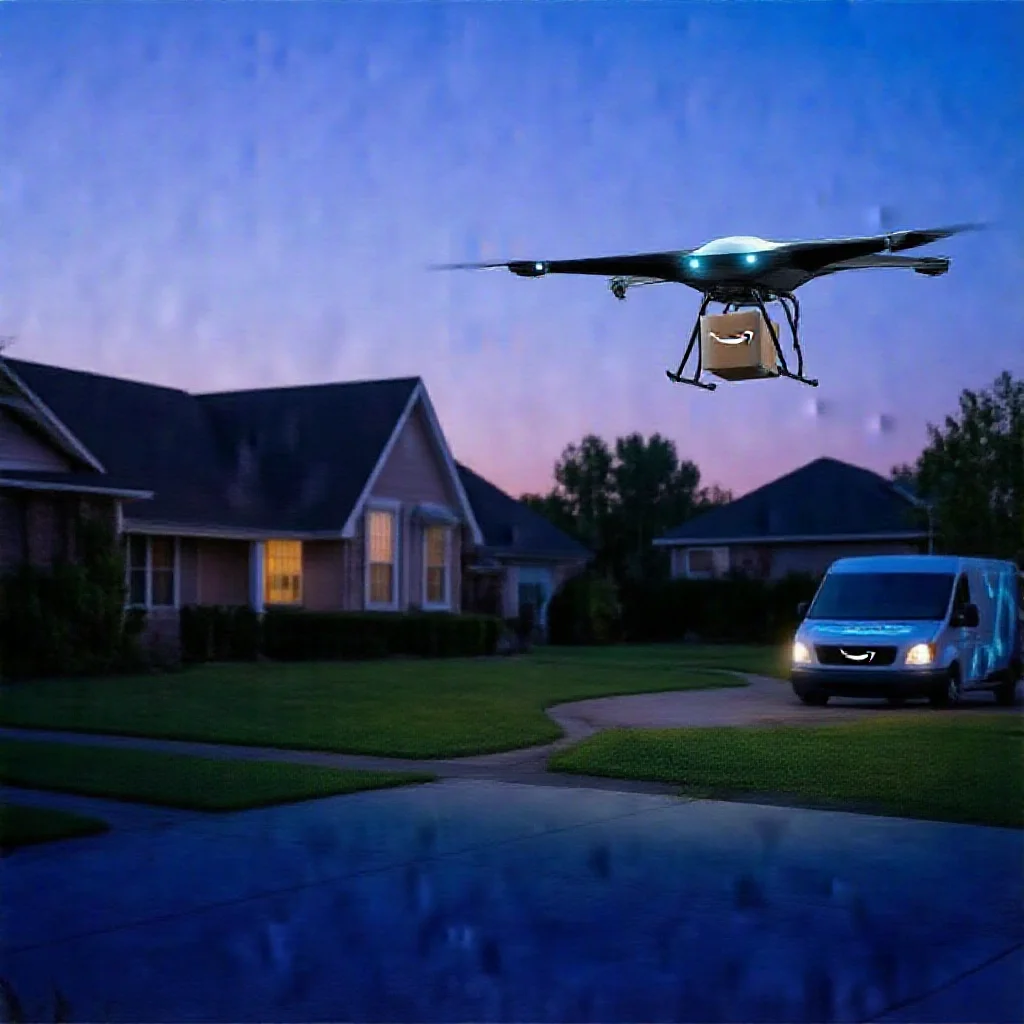
"Amazon CEO Andy Jassy's announcement of a 2026 target to scale drone delivery,"
Amazon's 2026 Drone Delivery Push: A Strategic Pivot or Last-Mile Logistics Gamble?
A statement by Amazon CEO Andy Jassy has refocused industry attention on the company's long-gestating autonomous delivery ambitions. During an interview with CNBC, Jassy announced a target to scale the company's drone delivery operations by 2026 (Source 1: [Primary Data]). This declaration establishes a concrete, medium-term horizon for a program first unveiled over a decade ago. The announcement moves the conversation surrounding Amazon Prime Air from speculative research and development into the realm of near-term operational strategy. The stated timeline invites analysis not merely of technological feasibility but of the underlying economic and strategic imperatives driving this renewed commitment.
Beyond the Headline: Decoding Jassy's 2026 Timeline
The specification of a 2026 target is a strategic communication with multiple audiences. For investors, it provides a measurable milestone against which to gauge management's execution on long-promised efficiency gains. The timing positions 2026 as a midpoint between the immediate pressures of post-pandemic logistics normalization and the long-term horizon for transformative automation. The choice of CNBC as the announcement platform underscores its function as a signal to financial markets and competitors, reinforcing a narrative of continuous innovation and operational dominance.
Analyzing the timeline requires contextualizing it within Amazon's broader financial posture. The period leading to 2026 coincides with intensified market scrutiny on profitability across all segments, including the historically high-cost logistics network. Announcing a scaling target serves to project control and forward momentum on one of the most stubborn cost centers in e-commerce.
The Hidden Economic Logic: Drones as a Margin Salvation Tool
The primary economic driver for drone delivery is the structural cost of the "last mile," frequently cited as the single most expensive segment of the e-commerce supply chain. This cost encompasses fuel, vehicle maintenance, and, most significantly, labor. A shift to automated drone delivery represents a direct attempt to reconfigure this cost equation.
The narrative around Prime Air is thus evolving from a public relations "moonshot" to a calculated return-on-investment project. The unspoken strategic goal is the systematic reduction of reliance on human drivers and third-party carrier networks, which would grant Amazon greater control over delivery costs, timing, and service quality. The profitability model hinges on achieving sufficient scale to amortize the substantial upfront investments in drone technology, fleet management software, and specialized infrastructure.
The Scaling Challenge: Technology, Regulation, and Public Trust
The 2026 target confronts a triad of non-trivial scaling challenges: technological maturation, regulatory clearance, and societal integration. Technologically, scaling requires solving for autonomous navigation in complex environments, battery energy density for extended range and payload, and all-weather operational reliability. These are incremental engineering challenges, but their convergence at a commercial scale is untested.
Regulatory progress, particularly with the Federal Aviation Administration (FAA), has been gradual but measurable. Amazon has received necessary Part 135 air carrier certification and has operated limited test deliveries in select U.S. locations. The path to 2026 scaling, however, necessitates evolved regulations for beyond-visual-line-of-sight (BVLOS) operations and dense urban airspace management—a multi-year process involving government and industry stakeholders.
Finally, community acceptance forms a silent bottleneck. Operational scale requires moving beyond controlled test towns to widespread suburban and urban operations, where noise, privacy, and safety perceptions will directly impact deployment speed and regulatory goodwill.
Deep Audit: Ripple Effects on the Underlying Supply Chain
A successful scaling of drone delivery would necessitate profound changes to Amazon's foundational supply chain architecture, not merely its final delivery leg. Fulfillment center design would require re-engineering to incorporate dedicated drone staging, charging, and maintenance bays, transforming warehouses into multimodal logistics hubs.
Inventory strategy could shift toward greater decentralization. The economic viability of drone delivery could promote the proliferation of micro-fulfillment centers located closer to population centers, holding fast-moving inventory for rapid aerial dispatch. This would represent a move away from the centralized mega-warehouse model for a significant portion of SKUs.
The long-term labor impact is speculative but significant. A drone-first ecosystem for suitable packages would gradually alter labor demand within the logistics network, potentially reducing roles in last-mile driving while increasing demand for highly skilled technicians, data analysts, and air traffic management specialists.
Conclusion: A Defining Bet on Amazon's Automated Future
The 2026 target represents a defining strategic bet for Amazon. Its credibility hinges on the company's ability to execute concurrently on parallel tracks: advancing core technology, navigating a protracted regulatory landscape, and designing a new layer of physical infrastructure. It is neither pure posturing nor a guaranteed success.
The broader implication is Amazon's attempt to use drone delivery as a wedge to fundamentally alter the cost structure of retail logistics. If successful at scale, it would not only improve Amazon's own margins but would also raise the competitive bar for the entire e-commerce sector, forcing rivals to invest in similar automation or cede the advantage in delivery speed and cost. The 2026 timeline sets the clock for a critical phase in the automation of the physical world, with Amazon's vast resources ensuring its progress will be a primary indicator of the industry's direction. The coming years will validate whether this initiative transitions from a strategic ambition into an operational reality.
Trade Metrics
Related Datasets
Q4 Cross-Border Logistics Report
PDF • 4.2 MB
Automotive Parts Supply Chain Index
CSV • 1.1 MB